
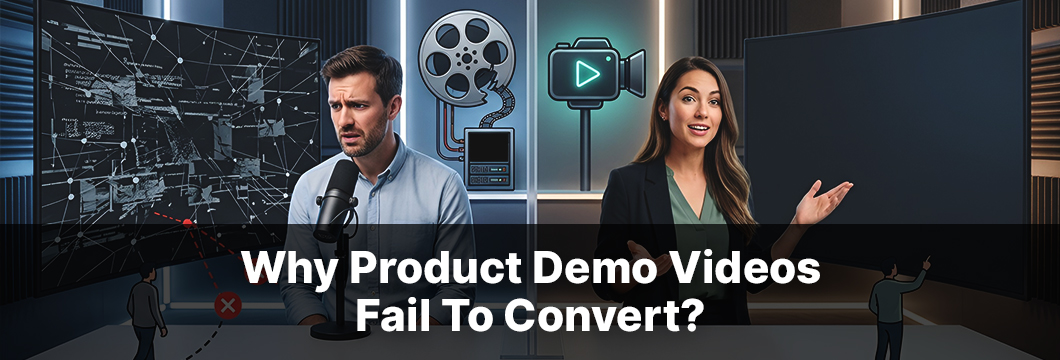
Why Product Demo Videos Fail To Convert
Every month you pour money into slick product demos, yet the real cost is the silent churn of viewers who quit before the call‑to‑action—often within the first thirty seconds. By exposing the hidden metrics and five fatal flaws that sabotage conversion, you’ll walk away with a checklist that turns those early drop‑offs into qualified leads.
Hidden metrics that expose a demo video's conversion shortfall
Look beyond high view counts and check your actual watch-through, click-through, and viewer drop-off rates. These hidden metrics reveal exactly where a video loses momentum and why product demo videos fail to convert. For instance, if a steep drop-off occurs at the thirty-second mark, viewers are likely losing interest before they ever see the call to action. Tracking these specific drop-off points allows you to edit weak sections of the script instead of scrapping the entire production.
Watch-through vs. bounce rates
Your watch-through rate shows how long people stay engaged, while your page's bounce rate shows who leaves immediately. Industry data reveals that most viewers decide to stop watching within the first ten seconds if the hook is weak. Analyzing this early drop-off point helps explain why product demo videos fail to convert long before the viewer ever sees your call to action.
Looking for reliable SaaS Video Agency?
We are here to help. Contact us today!
Storytelling missteps that turn viewers away
Stories that jump straight to features leave viewers unhooked. While you never know exactly what will go viral and must try different options, an original story behind the video is a must. Focusing on a clear, problem-solving narrative is essential when learning how to create a compelling product demo video.
No clear problem-solution hook?
Without a clear problem-solution hook, you risk building the wrong video asset that won't work properly for your campaign. Relying on technical jargon instead of addressing a real user pain point is a major reason why product demo videos fail to convert. Speak in plain language from the start and tie every feature directly to a practical benefit.
Production shortcuts that damage credibility
Bad lighting and muffled audio instantly hurt your brand's credibility. Research shows that poor audio quality directly causes viewers to distrust the speaker and dismiss their information. When viewers see dark visuals or hear background noise, they assume your actual product is also low quality. This visual distrust is a major reason why product demo videos fail to convert, sending potential buyers straight to your competitors.
Audience and distribution mismatches that mute impact
Publishing a demo to the wrong channel or targeting the wrong persona mutes its impact. You must match the video format to where your audience actually spends their time. For instance, a detailed technical walkthrough fails when forced into SaaS Video Marketing On Social Media, where users expect rapid visual proof. Map every video asset to a specific buyer stage to address their immediate objections.
Ignoring platform norms and persona segmentation
Ignoring platform norms—like optimal length for TikTok versus LinkedIn—reduces reach from the start. When running SaaS video marketing on social media, uploading a single generic video across different channels fails because audience behavior differs on each platform. A LinkedIn user expects professional context, while a viewer on a mobile-first platform drops off if the product is not shown in action within the first three seconds. Tailor the pacing, aspect ratio, and messaging style to each channel's native expectations to keep viewers watching.
The top 5 fatal flaws checklist
Before publishing, audit your asset against five critical issues: a missing call-to-action, an overly long runtime, heavy technical jargon, poor production quality, and audience mismatch. These major flaws explain why product demo videos fail to convert. For instance, industry data shows that audience engagement drops sharply after the two-minute mark, making brevity essential. Scan your drafts against this checklist to ensure your message actually lands.
No explicit call-to-action
Without a clear call‑to‑action, viewers don’t know the next step. End every demo with a direct, easy request.
Excessive length that exceeds attention span
Videos that exceed the typical 2‑minute attention span lose viewers. Keep content tight and focused on the core benefit.
Real-world turnaround: case study of a 3-point conversion lift
One B2B SaaS client increased their demo conversion rate by three percentage points after we restructured their video. Their original draft delayed the actual product walk-through with a long, slow introduction. We cut the fluff, placed the most valuable features in the first 30 seconds, and added a single, direct call to action. This fast pacing kept viewers engaged and guided them directly to the trial signup page.
Before-and-after metrics and edits
Post‑edit metrics showed watch‑through rise from 45% to 68% and click‑through double. Simple edits can drive measurable gains.
Conclusion
In short, low conversion stems from hidden metric blind spots, weak storytelling, poor production quality, and audience‑distribution mismatches. Use the five‑point checklist—clear CTA, concise runtime, plain language, high‑quality production, and audience alignment—to audit every demo. The case study shows that fixing these issues can lift watch‑through and click‑through rates dramatically. Apply these diagnostics and you’ll turn underperforming demos into reliable conversion tools.









Similar articles that you may like:
19. Why Product Demo Videos Fail To Convert
18. How To Choose SaaS Video Production Partner
17. Affordable SaaS Video Production Agency Case Studies
16. Cost To Hire Blockchain Explainer Video Agency
15. Mobile App Explainer Video Agency Vs Freelancer
14. Enterprise Video Production - UltimateVideo Services
13. SaaS Video Ad Best Practices For High Conversion
12. Hire Corporate Video Production Services for Tech Brands
11. Teaser Vs. Explainer: When To Use Which For SaaS Launches
10. Best Unlimited Video Editing Service For Businesses
9. SaaS Video Production: In-House vs. Agency Guide